

The Price of an Imperfect Union
Reflections on America’s 250th Year

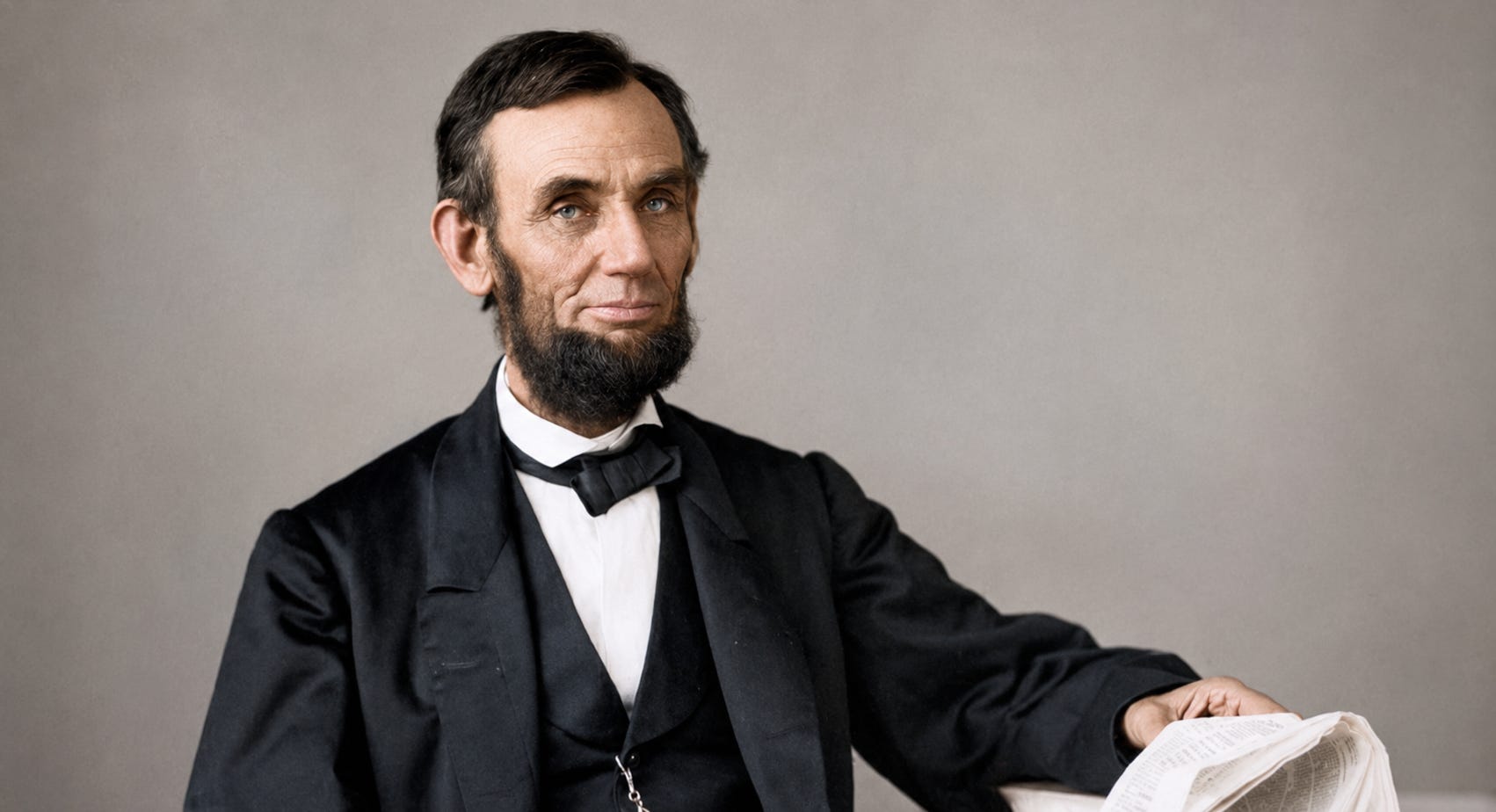
*This essay first appeared with Mere Orthodoxy, here.
On September 17, 1862, Union forces — 87,000 men under the command of George McClellan — engaged the Army of Northern Virginia, a much smaller force of 55,000 men under Robert E. Lee, near Sharpsburg, Maryland. The Battle of Antietam remains the bloodiest single day in American history, with a staggering 22,000 casualties. Though a Union victory, the battle exacted a cost — felt not just by the men, but by Lincoln, who was 50 miles away in Washington, D.C. By the time of this conflict, the divided nation had already suffered just under 200,000 casualties, a staggering number for a war not yet 16 months old.
Lincoln had been waiting for the right moment to present the Emancipation Proclamation, which sat in draft form on his desk — awaiting a victory before he could declare that all men were not only created equal but were free.
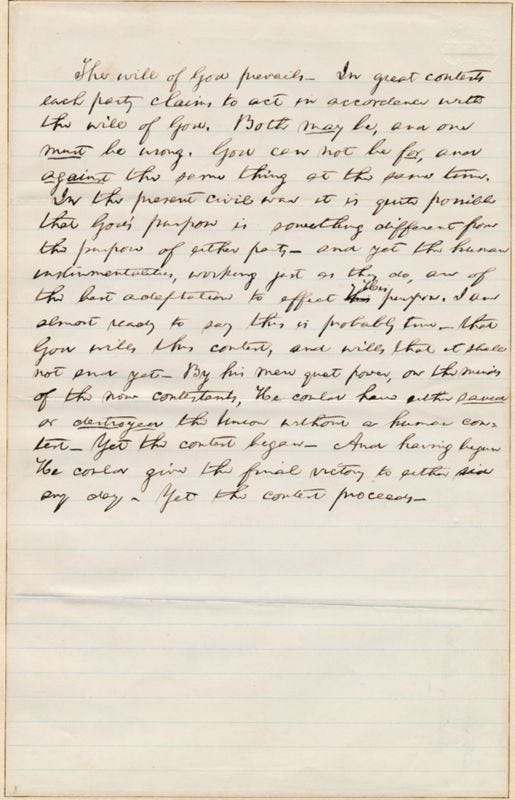
As he sat at his desk, he jotted his reflections on a piece of paper. This was not meant for public consumption but was an internal wrestling with the conflict at hand. Lincoln wrote: “The will of God prevails. In great contests each party claims to act in accordance with the will of God. Both may be, and one must be, wrong. God cannot be for and against the same thing at the same time.” Lincoln was seeking to reckon with the staggering loss of life. How could so much bloodshed happen? What was the price of freedom worth? He went on: “I am almost ready to say that this is probably true — that God wills this contest, and wills that it shall not end yet.”
Now, approximately 163 years later, we celebrate the 250th anniversary of this great nation. As I ponder what it means to be a Christian and an American, I can’t help but think back to Lincoln’s internal turmoil. For while we certainly do not have open armed conflict today, there is spiritual and invisible conflict. With each issue, we seek the Divine Will — and we, like Lincoln, often wonder: what is right and what is wrong. But I also can’t help but think of Joseph, who in the book of Genesis is dealt every manner of hardship and trial — being sold into slavery by his brothers, falsely accused by Potiphar’s wife, and cast into prison, left to rot in the depths of despair. Anyone would think in that moment that God was not with him — and yet He was, very much so. For through the very hardship Joseph experienced, God was fully at work. Joseph was ultimately elevated to the right hand of Pharaoh on account of God’s divine mercy, and through the very actions of his brothers and Potiphar’s wife, Joseph was restored. For what man intended for evil, God meant for good — that through one man, Joseph, and ultimately Jesus, many should be kept alive.
As Lincoln struggled internally with this conflict — a struggle that would have been lost to history if not for John Hay, one of Lincoln’s secretaries — he wrestled with the question that many of us wrestle with today.
This meditation on the Divine Will was, I believe, the kernel that became the Second Inaugural Address, in which Lincoln proclaimed: “Both read the same Bible and pray to the same God and each invokes his aid against the other…the prayers of both could not be answered…the Almighty has His purposes.” In the closing paragraph he spoke with the eloquence of the greatest American poet: “with malice toward none, with charity for all, with firmness in the right as God gives us to see the right, let us strive on to finish the work we are in, to bind up the nation’s wounds, to care for him who shall have borne the battle and for his widow and orphan — to do all which may achieve and cherish a just and lasting peace among ourselves and with all nations.”
In a letter dated June 1865, Samuel Haycraft — a longtime friend of the Lincoln family and circuit clerk of Elizabethtown, Kentucky — wrote to William H. Herndon, Lincoln’s friend and law partner, who was gathering information for a biography of his late friend. Haycraft wrote: “It may be called fanaticism in me but it looks to me as if the Lord had raised up A. Lincoln for the special purpose of blotting out Slavery.” In another letter, this time from Augustus H. Chapman to Herndon, Chapman recorded what Thomas L. D. Johnston had found in Lincoln’s notebook. Lincoln had jotted down the first two stanzas of the hymn “The Shortness of Life, and the Goodness of God”:
Time what an empty vapor tis
And days how swift they are
Swift as an Indian arrow
Fly on like a Shooting star
The present Moment Just is here
Then Slides away in haste
That we can never say theyre ours
But only say they are past.
Many wish to paint Lincoln as a devout evangelical, for which I find little evidence. But as Lincoln’s friend Leonard Swett once observed:
You ask me whether he changed his religious opinions towards the close of his life. I think not. As he became involved in matters of the gravest importance, full of great responsibility and great doubt, a feeling of religious reverence, and belief in God — his justice and overruling power — increased upon him. He was full of natural religion; he believed in God as much as the most approved Church member; yet he judged of Providence by the same system of great generalization as of everything else. He had in my judgment very little faith in ceremonials and forms.
Whether Lincoln was a true Christian or not is, in the end, beside the point. He was — I am quite certain — used by God in his Providence to hold together the bonds of the Union in the face of almost certain rupture. Two hundred and fifty years later, we stand — though quite divided underneath — united in the fact that we are Americans. And we can look back on Lincoln’s meditation on the Divine Will and see that he too wrestled with a divided nation, but did not give up hope for it.
As I reflect on America 250 years later, I think of two blood payments. The first: the men who died on fields like Antietam — who died on American soil, by American weapons, in towns and streams and mountains with American names — and Lincoln himself, who died at the end of the conflict and did not live to see beyond it. Though they did not live to see the result, the blood they shed was enough to purchase an imperfect Union — the very imperfect Union we have today. But I am also reminded of the blood spilled by Christ, who conquered the grave. For as Paul writes in Galatians 3, “Christ bought us with His blood.”
Two hundred and fifty years later, we may be prone to look back to the beginning — to the birth of a new nation. And while this is certainly cause to cheer, it is the blood paid at the moment of divide that may hold a better lesson for us today. When we look back at the events of 1861–1865, we see the roots of many scars we still bear and wounds that remain. Either we will abandon the cause and throw in the towel, or we, like Lincoln, will understand that though the pains are real, the cause is worth it. For together we are Americans, and divided we are merely another power doomed to the shipwrecked seas of history. As a Christian, I am thankful that the Divine Will — the Sovereign Hand of God — is at work upholding and sustaining.