

The Right Stuff for Life
why the manosphere can't make you a man, but the right stuff can


When you have kids, it changes you. Your plans get bigger and more expensive. Your time gets more limited. Your house gets smaller and smaller. And your life just gets a tad more hectic. But in the best ways.
With the birth of my son, I’ve been thinking a lot about young men today. I technically still count as one, but namely I’m thinking about young men in their twenties. There’s a lot going against them — the culture telling them they are terrible, the manosphere teaching them to be jaded, and an economy making upward mobility nearly impossible. I don’t expect my son to grow up and find these issues resolved. But I do hope that we can bring back some of the right ways of thinking about being a man.
There are a few points for me to say before digging in. First, this piece is mainly for men, but please, don’t let that stop you from reading it (the principles are pretty universal). I say it’s for men because it’s young men that I have in mind as I type away. Another way to say it: this is advice I wish I knew when I was younger.
Second, this is not meant to be manosphere slop. If you’re looking for a “rage-against-the-world” kind of post, or the “dominate everything around you” kind, then it’s probably best to just skip this whole thing. I’m disinterested in that type of work because I’ve seen it produce men who are full of anger and rage and really don’t have “the right stuff” — at least in the way Tom Wolfe describes it. We will get to this in a bit but think of it this way. If an astronaut makes a mistake or is hurt by something someone says, do they allow their anger to impact their job? I doubt it. Their job is to keep them and their fellow travelers safe.
Third, I couldn’t be an astronaut — bad eyesight alone would disqualify me. But I do have three younger Gen Z brothers and I’ve seen them go through some really, really hard things. I’m not writing this as someone living the perfect life and telling you how to do so as well. Instead, I’m writing this to myself as much as to you, reader. The right stuff of life takes a lifetime to develop. It’s not something you can just do overnight. That’s one of the shortcomings of the manosphere — it teaches that you can just watch a video and become the best man you can be. I’m here to tell you that like the men Tom Wolfe talks about, you need to put in the work to get the result. Now to the meat.
In the evenings I’ve been reading Tom Wolfe’s The Right Stuff. It’s been a thrilling read and it really brings out the “young boy” in me. When I was a kid, my parents took me to Kennedy Space Center. On the drive down from New York, I had some construction paper and crayons. I vividly remember drawing the white space shuttle on the orange paper — the takeoff of one of the mightiest creations of man. Seeing them in person was even more enthralling. The power and force needed to propel a person out of this atmosphere and into space is staggering. It isn’t far off to say astronauts were seated on a giant bomb that pushes them out of this world. It wasn’t until I was a bit older that I learned about Apollo 13, and to this day I believe it is one of the greatest feats of modern man — circumnavigating the dark side of the moon with almost no power and slingshotting back to earth. (When I’m not thinking about cowboys, I’m thinking about astronauts.)
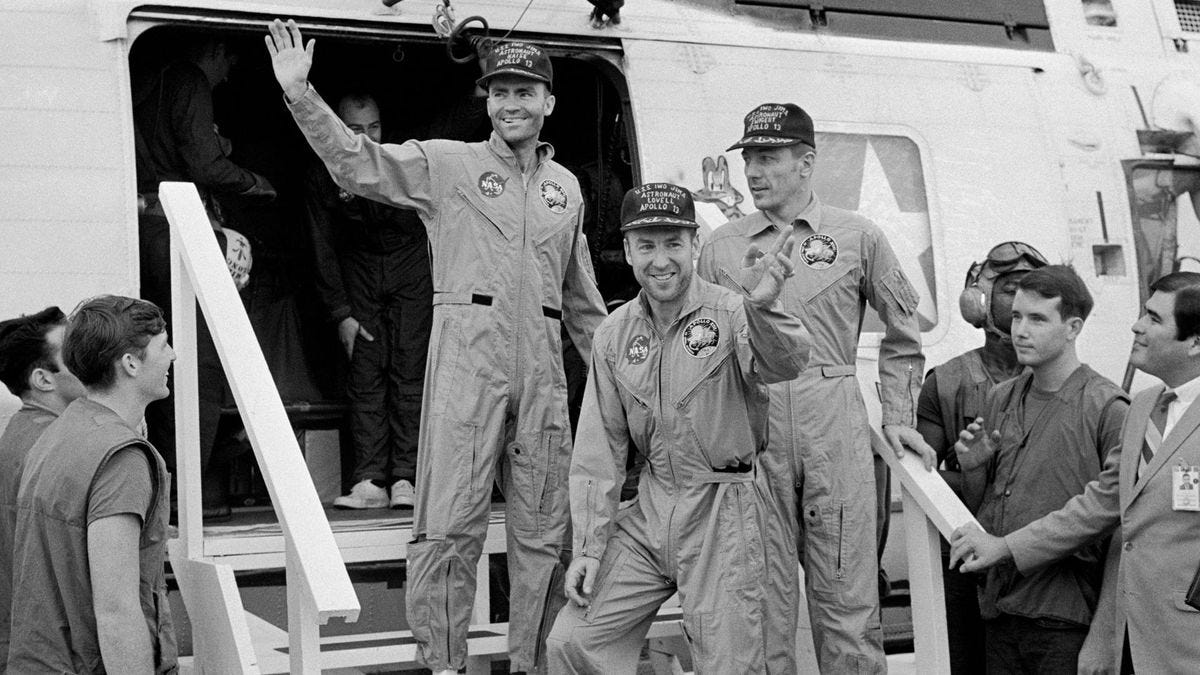
Wolfe's book is intriguing because where most space books look at the brains behind the operations (von Braun, for instance), Wolfe looks at the human side. What makes someone want to — or even be able to — strap onto a flying missile and touch the stars? Astronauts tend to be larger than life, thanks in no small part to Hollywood. They are the frontier explorers of the twentieth century. And yet at the end of the day they are people like you and me. They make mistakes. They get scared. They have a failure of nerve. And yet they aren't quite like you and me either — because they are doing something most of us never could.
Of course, there’s more to it than pure willingness for the adrenaline rush. Wolfe says as much:
“After all, the right stuff was not bravery in the simple sense of being willing to risk your life…Any fool could do that (and many fools would no doubt volunteer, given the opportunity), just as any fool could throw his life away in the process. No, the idea (as all pilots understood) was that a man should have the ability to go up in a hurtling piece of machinery and put his hide on the line and have the moxie, the reflexes, the experience, the coolness, to pull it back at the last yawning moment.”
The best have the stuff, and they have the dedication to become the best. Wolfe says that “the best pilots fly more than the others; that’s why they’re the best.” Notice he doesn’t say they watch flight videos or listen to flight radio broadcasts — no, they do it. They practice by doing it. Maybe there’s something there for our screen-obsessed world.
So what exactly is the right stuff? The right stuff is first an unspoken code. It’s never really spoken aloud among pilots and astronauts. No one goes around and says “Hey, I think I have the right stuff.” Instead, it’s a quality that is lived — a concoction of courage, skill, coolness under pressure (literally under G forces of pressure), and an almost transcendent self-composure. According to Wolfe, to name it would diminish it.
The right stuff is also a hierarchy. Our culture hates hierarchy. We disdain those who are older than us. We disrespect those in leadership. It’s actually a mark of honor to do so these days. But among pilots and astronauts, there is a single ladder leading to the top. If you are pretty good, but not good enough, you fly the cargo planes. Wolfe comments that while this is not explicitly seen as a mark of shame, the unspoken code makes it so. The hierarchy isn’t necessarily about rank — it’s about merit and ability. Chuck Yeager, “Mr. Right Stuff,” was elevated because of his ability, not his rank. We balk at this today. “Why does so-and-so deserve this and I don’t?” Well, sometimes others are better than us. And that means we need to work harder.
The right stuff also has a religious underpinning. There’s a “grace under pressure theology.” To Yeager and his fellow pilots, there is something worse than death — panicking, or losing cool under pressure. Dying is inevitable in life and even more inevitable when you are flying at supersonic speeds. But panicking…that’s something you can control. It’s certainly not easy, but it’s doable.

There’s also the glory found in obscurity. Wolfe picks up on what he calls the astronaut paradox. When we think of astronauts, we think of the men who take the flight into space — the Mercury Seven: Alan Shepard and co. These seven were what fellow pilots dismissively called “spam in a can,” the men sealed inside the capsule. But Wolfe highlights the irony that the most dangerous and most overlooked job belonged to the test pilots, who risked their lives far more frequently. Again, there’s something to this. We think in order for our work to count, it needs to be seen. We need a following. We need a platform. But the right stuff says “I’m going to do this task even if no one sees me do it.” We need more men to be the test pilots, and fewer to be the front-facing astronauts.
So what does Wolfe’s The Right Stuff have to do with being a man? I think deep down all of us men would love to be astronauts. To touch the stars. To take a step where no man has ever stepped. To explore God’s creation not just from the ground but from the sky. Even looking up at the grand expanse of stars on a summer night, you can’t help but think: the world is so immense and I am so small — maybe, just maybe, if I travel up there it will feel a bit smaller.
First, the practice principle. Wolfe comments that the best pilots get there by flying more. There’s something convicting in that for our digital culture. Instagram reels and TikTok videos give us seconds of information about how to be better men. “Read Aristotle between reps at the gym.” “Become intentionally celibate because there are no good women anymore.” Flex your facial muscles daily for a sharper jawline. All of these things seem reasonable because at the end of the day they cost us almost nothing to do. But becoming a good father, a good friend, or following Jesus well — those take time and effort. You can’t shortcut them. The practice principle is simple: to get the right stuff, you have to put in the work.
Second, the right stuff recognizes that hierarchy isn’t a dirty word. This isn’t going to make me very popular, but I’ve written about this elsewhere (“Gen Z’s Authority Crisis”). We need order and structure. I understand that many feel taken advantage of — boomers have the house and the retirement fund — but even still, we need to respect those in authority and those who are wiser and older. Sadly gone are the days of “yes sir” and “yes ma’am.” We try to treat our kids like our friends, our friends like our inferiors, and our family like a ball and chain we just need to break away from. The right stuff accepts authority. It says that to earn respect from others, you have to show respect to others. This is also where meritocracy enters. It’s a dirty word today, and I’m sure many will take issue with it. But to be the best, you have to literally be the best — and that requires effort that puts distance between you and where you started. An astronaut can’t just be an average person. Today we are told that if we don’t have the right stuff, there’s nothing wrong with us — there’s something wrong with the system. I can’t speak for every situation, but in many ways hierarchy protects us. We want the best doctor. We want the best pilot. And we should all strive to be our best. Young men used to dream of being something great. Today young men watch other people stream about being great. I’m partially convinced that one of the roadblocks is this: to be great, you have to put in the work. Merit is required.
Third, the right stuff often lives in obscurity. Would you do it if no one was watching? This applies to personal health, work, parenting, spiritual life, marriage, and more. For every astronaut in the can, there were hundreds of test pilots risking their lives to make sure everything worked. Everyone sees the astronauts. The test pilots do the work behind the scenes. I’m reminded of the famous flag-raising photograph from Iwo Jima. The first flag went up before anyone had a camera ready. By the time a photographer was set, most of the men who’d raised it had died. So the photographer had others stand in for them. We remember the second group — but the first group were the ones who actually secured the mountain.
Fourth, the right stuff knows there’s an unspoken code of conduct. There have been plenty of instances in the news lately of people doing nothing for others in the face of danger. There’s a level of isolation and self-preservation that makes sacrificing for others feel unappealing — even foolish. But to have the right stuff is to know that when the moment comes, it’s better to step up than to stand by. If you have the right stuff, you help those in trouble. You look out for those in need. And even when you don’t get that dramatic moment, you do the small things. Hold the door. Help the older woman with her groceries. Make the person behind the counter smile — they’re probably having a rough day. The code of conduct is what separates the men who have the right stuff from those who don’t.
There are so many more points I could make, but the main takeaway is this: the manosphere offers a cheap and instant solution. Wolfe shows that the right stuff takes time and energy. It takes years of showing up, failing, correcting, and showing up again, only to fail again.
To have the right stuff, you have to dedicate your life to living the right stuff. It’s going to take time and work, but it’s worth it, I promise.
Today, there’s plenty of the wrong stuff out there — anger, isolation, fear, entitlement. The manosphere trades in all of these, dressing them up as strength. But what Wolfe describes is something older and harder than rage: a quiet, practiced excellence that doesn’t need an audience, and strives to work hard. I hope that more young men try to develop the right stuff, and though they won’t all be astronauts, they will certainly do extraordinary things even in the ordinary of everyday life.
So much good stuff here. Going to print it off and put it in a box of things saved for the boys.
I love the seeming conflict in working hard to be great, and being okay with obscurity.
"The right stuff knows there’s an unspoken code of conduct."
We might need to speak the unspoken code of conduct to bring it back. Which is what you're doing!