

Fear and Wonder
On Aliens, Astronauts, and the God Who Came Down


On May 8, the Department of War released never-before-seen files on Unidentified Anomalous Phenomena (UAP). With the declassifying of this massive trove of information, propane was thrown on a fire that has been smoldering for nearly eighty years.
While many have offered their thoughts on the phenomenon, I concur with Rod Dreher that the UFO quest is a deeply religious phenomenon. Rod writes:
There are a startling number of quite intelligent and influential people who believe that these intelligences are coming to us as “gods,” to solve our problems and lead us to an age of enlightenment and progress. “Aliens” are the kinds of godlike beings that a secular society — one in which science and technology hold supreme authority — can believe in when they have discarded the God of the Bible.
We live in a time dominated by the present. Christopher Lasch finds that modern narcissism consumes itself and has no use for the past or the future. This narcissism has arrived on the coattails of another factor: the unbridled advancement and acceptance of technological progress. Aware of our own limitations, and seeking to transcend them, we avoid anything that might remind us of the true nature of reality — that we are finite beings, that our time is short, and that our bodies are limited. Instead we proclaim ourselves infinite, as long as we put our minds to the task.
Of course not all technological progress is bad. I am certainly in favor of things like anesthesia, which has genuinely improved medicine. But what I am referring to here is the desire to become more than we are — to expand beyond the limitations of our bodies. The push to upload human consciousness to a cloud in order to “live forever” is perhaps the most egregious example: an attempt to sever the person from the very thing that makes him one.
I should say clearly: this is not going to be a deep dive into the facts of aliens. As I said, I align with Rod on this issue, especially where he writes that aliens, “whatever they are, are a kind of solution to save us from the burden of disenchantment.” He continues that “they would be the ultimate gods of a technocratic civilization that abandoned worship of the true God and instead had for some time been worshiping the work of its own hands.”
In other words, whether literally or figuratively, this phenomenon is demonic in nature — whether it is literally supernatural or merely functioning as a substitute religion, the effect is the same: a distraction from the cosmic reality of spiritual life. The Cross is a cosmic event that punctured history. Over time we have lost this sense and retreated into a lethargic technocratic stupor. The popularity of UFOs is, to me, indicative of our desire for something beyond ourselves.
But back to the purpose of this essay: I hope to show how the alien and the astronaut are archetypes in the collective conscience — how and why modern people are so fascinated and frightened by the unknown, and yet so driven by the insatiable desire to explore and expand.
Two Archetypes
The astronaut and the alien capture two archetypes within the modern mind. Modern man desires to explore — to go beyond the atmosphere and touch the sun. But he is also fearful of the unknown — always wondering whether something more lurks beyond the visible.
They are, in fact, twin mythological responses to humanity standing at the edge of the unknown. One archetype fears what might cross the threshold; the other longs to cross it himself.
But these two archetypes are not new. Mythology is full of such figures — the hero who descends into Hades to conquer, and the monster who arises from the underworld to torment the world.
Space is the arena, but there were others before it. Before space it was the frontier. The explorer traversed rivers, trudged through forests, and endured the hardships of the wild in order to find a better place.
There is, of course, the ultimate cosmic story — one that is true, unlike the others. In this story the serpent lies in the garden, an intrusion into the cosmic order. Man, by seeking to be like God, is cast out from perfect union with Him. From that point he spends his days seeking to repair what has been lost — traveling, wandering, always reaching for something better. Only when God Himself descends in the Incarnation, conquers death in the resurrection, and opens the way back through faith, is man finally brought home. In many ways, all these stories reflect this one. We seek the beyond because we sense something missing, something deficient within ourselves — and we know that the only true peace must come from somewhere beyond time and space. From God Himself.
The Astronaut
On September 12, 1962, JFK stood at Rice University and proclaimed the era of progress:
If this capsule history of our progress teaches us anything, it is that man, in his quest for knowledge and progress, is determined and cannot be deterred. The exploration of space will go ahead, whether we join in it or not, and it is one of the great adventures of all time, and no nation which expects to be the leader of other nations can expect to stay behind in the race for space.
He sprinkled his speech with explorer optimism, calling space a “new sea.” He then shifted to his famous line — and you can hear his Massachusetts accent even in reading the words: “We choose to go to the moon.” Kennedy was drawing on the historic will of the American people — the same people who traversed the rough terrain of the American wilderness. But this time he pointed it upward.
Percolating beneath the optimism, however, was the Cold War. Kennedy did not frame the speech as a military objective — the word Russia is absent entirely. Instead he cast the moon as the ultimate expression of human existence: to progress beyond boundaries, to achieve the seemingly unachievable.
But the fear was there. In 1957, the Soviet Union had put a satellite into orbit. In 1961, they put a man there. Each achievement landed in the American imagination less like a scientific milestone and more like a warning — proof that the sky was no longer safe, and that an adversary was moving through it. Unlike World War II, this enemy was relatively faceless — known only through propaganda and occasional glimpses. Hitler had given the German enemy a face. Hirohito had given Japan one as well. But the Russians, though they had Khrushchev, remained largely faceless to the American people.
The space race was, in many senses, the clash between the Alien and the Astronaut played out on a geopolitical stage. The Soviets were the alien — faceless, unknown, their progress hidden until the moment of announcement. There was no clearly defined human face to the enemy, no single figure the American public could locate or read. They were simply out there, moving in the dark.
This existential dread — the possibility of annihilation from above — drove the American industrial and scientific machine into motion. Slowly, with Kennedy’s call as its catalyst, it pushed to overtake the alien. The American Astronaut was born not purely from wonder, but from fear transformed into mission.
It is little wonder that Star Trek opens with “Space: the final frontier.” For the Puritan founders of America it was a “city on a hill” — a people traversing the ocean toward the unknown in hope of something better. Once settled, the frontier shifted west. The explorer, the pioneer, and the homesteader were all astronaut figures. But as the frontier diminished and technological capability grew, space opened up, and with it a new kind of pilgrim. That is what the astronaut is: a cosmic pilgrim, moving from this world into the next, a link between two very different spaces.
The Alien
In 1963, the movie The Day Mars Invaded Earth was released. The story is emblematic of the time in which it was made. NASA successfully lands a robot on Mars to survey the planet. Shortly after landing, the rover is destroyed. Immediately, Dr. Dave Fielding, the man presiding over the project, begins to feel disembodied — like he’s there but not really.
Dave decides to take his family on vacation. While there, they discover that he has a body double — present at the very place they are staying. The double reveals that Mars is inhabited, that the aliens are formless — energy-like — and that they traveled via radio transmission back to earth.
What is interesting about this story is that it captures the ultimate fear of the alien. The film gets at the heart of it precisely: the alien arrives not through invasion but through us — through our own insatiable desire for progress. We trigger the aliens to come. And they do not simply destroy us. They replace us. The deepest fear of the other is not that it will come to earth obviously, loudly, with ships and weapons. It is that it will come quietly, and we will not know it is here until it is too late.
The Cold War context matters here. The real fear animating films like this one — and Invasion of the Body Snatchers — was that the alien threat was not outside the gates but already among us, indistinguishable from us. The alien is not frightening because it is foreign. It is frightening because it is familiar.
Christian cosmology has language for all of this. There is a cosmic spiritual battle underway — principalities, powers, forces operating in the unseen. The demonic is, by its very nature, the invasion of the hostile and chaotic into the ordered cosmos. The alien of modern imagination is an old figure in a new costume.
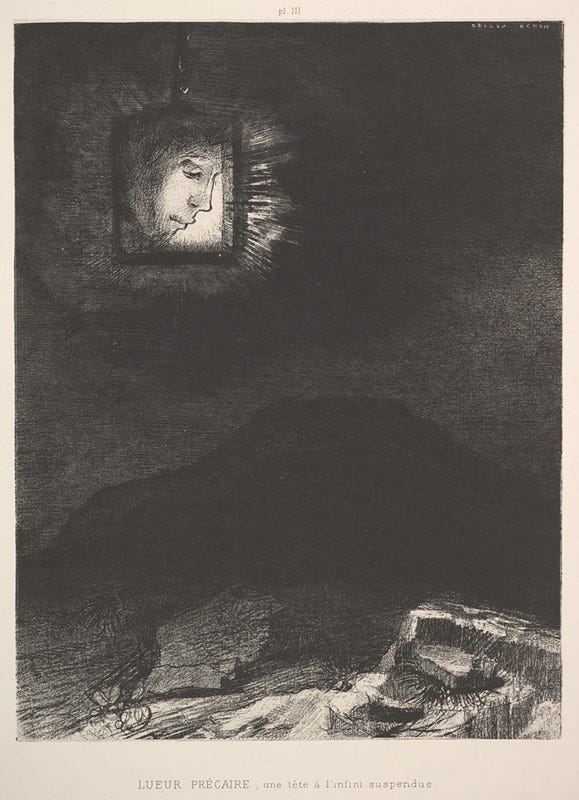
And yet many believers today live as though no such battle is occurring. I know I can fall into this trap myself. We are pragmatists. We are empiricists. We tend to what troubles us and ignore what does not, and an invisible war has a way of feeling optional — especially when it makes no obvious demand on the ordinary day. In other words if we can’t see it or feel it, we ignore it.
But the modern obsession with UAPs suggests that our attempts to quiet the deeper intuition have largely failed. Despite ourselves, we still wonder and even fear what lay beyond the stars. We still look up and try to count the stars — I surely have. Something in us refuses to accept that the visible is all there is; that there is something beyond what we can see. We look up UAPs, and marvel at the mystery and wonder “is there something more.”
I am not convinced — nor do I think it is neccessary — that there is extraterrestrial life beyond this earth. Nor do I think the human heart’s deepest need is waiting at the outer rim of the solar system. But I do think this restless hunger — for the beyond, for the other, for something that transcends what we can measure — is pointing somewhere real. We desire something beyond because there is something amiss within.
Christianity offers the final and truest version of this story. God himself steps into time and matter, crossing every threshold, in order to bring us back to himself. It is the ultimate cosmic narrative: not man reaching upward and finding nothing, but heaven reaching downward and finding us. This, I believe, is the story that all of our obsession over UFOs really points to — we long to know the unknowable. Thankfully the unknowable has made Himself knowable.
A rousing and Lewisian conclusion indeed: "But I do think this restless hunger — for the beyond, for the other, for something that transcends what we can measure — is pointing somewhere real. We desire something beyond because there is something amiss within.
"Christianity offers the final and truest version of this story. God himself steps into time and matter, crossing every threshold, in order to bring us back to himself. It is the ultimate cosmic narrative: not man reaching upward and finding nothing, but heaven reaching downward and finding us. This, I believe, is the story that all of our obsession over UFOs really points to — we long to know the unknowable. Thankfully the unknowable has made Himself knowable."
A very well-written essay on the topic, but I am not sure I follow the argument that UAPs must present a demonic force. For instance, what is the basis for believing that most of mankind would react to a "first contact" situation in a way where the visitors are treated as godlike? I understand that a recurring theme in science fiction is that less-developed civilizations regard those with more advanced technology as gods, but this is more of a plot device than a settled matter of cultural history. I do believe that some of what is witnessed may represent a truly evil nature, but I am not sure demonic is quite the right description. According to an interesting book (UFOs: Generals, Pilots and Government Officials Go On the Record) by a recognized journalist, for instance, there are disturbing details about the shutdown of a missile range facility in the fall of 1966. Is the shutting down of military installations something we can view as purely spiritual in nature? Seems something else is potentially at work here. Despite the distractions, we do need to keep our eyes fixed upon Christ; this doesn't mean, however, that we ignore potentially dangerous activities by forces we fail to understand. After all, they may be neither aliens nor spiritual entities at all; we don't seem to have many answers at present. (My own blog post on this topic from years ago can be found at https://singinginthewood.blogspot.com/2023/08/the-uap-question.html .)