Conspiracy Theories are Simple . . .
Ruminations on societal complexity, conspiracy, and the slow outsourcing of our minds

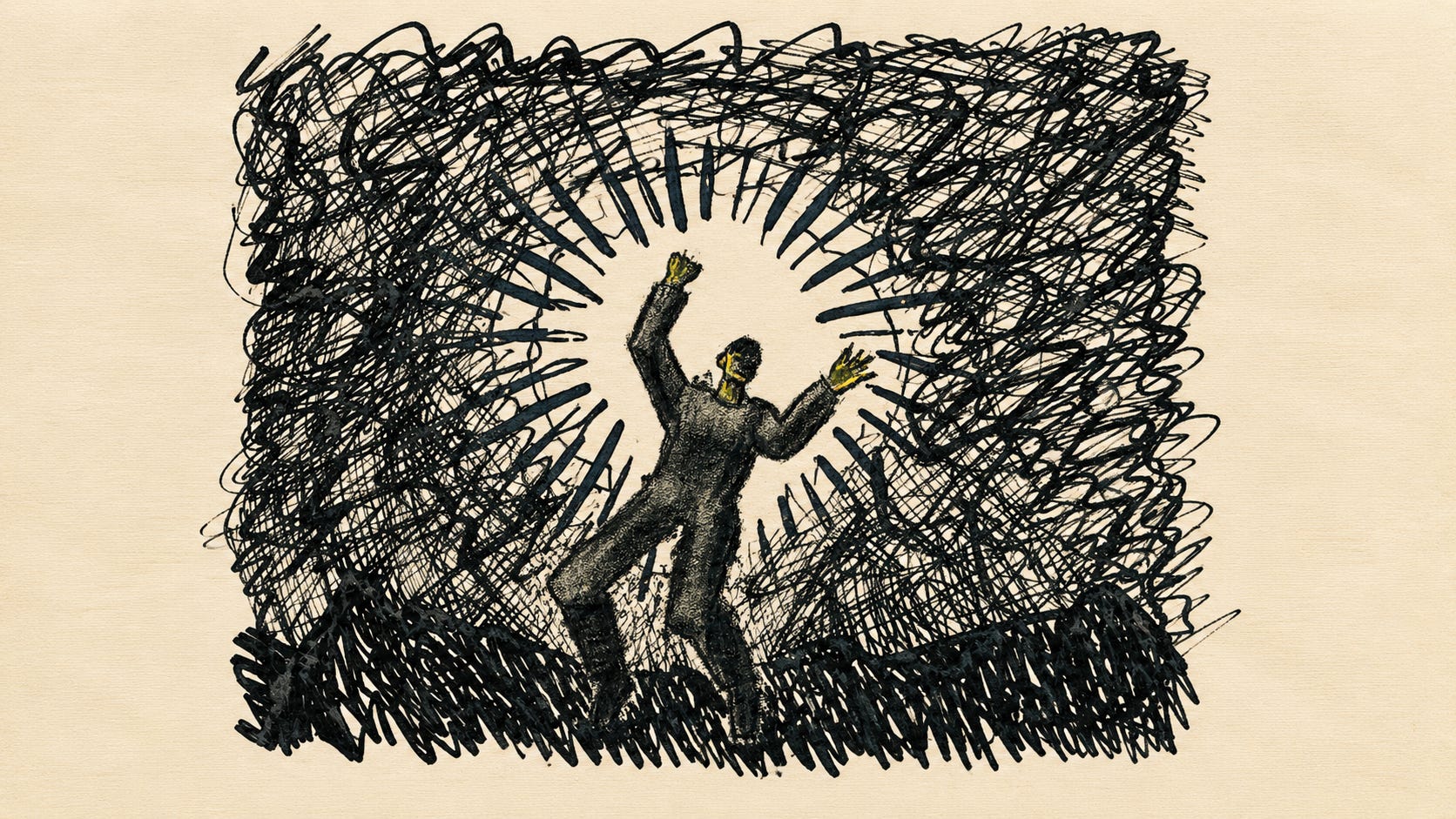
Societal Complexity and the Conspiracy Mind
We all have those questions that sit latent in the back of our minds, only to appear when we are standing in line at the grocery store, or in the shower. For me that question is the complexity of society. Why is it that society, over time, grows more and more complex? Or to frame it another way, why does the arc of complexity move up and onward? And linked to this, could this perhaps explain why so many are falling for conspiracy theories? I’ve been a bit taken aback lately by the theories not only surrounding Charlie Kirk’s death, but also the accusations regarding Patrick Clancy in the trial dominating the news. How is it that in an age of abundant information, we are falling for theories that are blatantly false?
Defining Society
But to start we need to first define what a society is before we can talk about how it is a complex entity and the signs of decay. A society is the web-like connection created by the interactions between a group of people over time. Society is not free-floating in the air. It’s not floating around only to blow away when the wind picks up enough. Instead it is more like sediment that over time accumulates and builds up. Culture draws on prior layers as it makes a new layer. Eventually another layer is built. In this way we can see traces of former layers, artifacts of older eras, but even those over time are covered and new sediment is placed on top.
Society is the habits, behaviors, practices, and relics of those who currently dwell on the earth. Of course we are all united in being human, but each area has unique habits, customs, and practices which give each society a cultural marker. These cultural markers place each of us in a particular time and place.
The Compounding of Complexity
If society is the web of human interaction, then what do we mean by its complexity? Over time society builds up cultural sediment. This sediment takes the form of music, literature, language, information, and scientific exploration. Each generation takes these advancements from earlier generations and builds upon them. Electricity gave way to the computer, which gave way to the Internet, which gave way to the smartphone.
Ancient Rome, at one point the pinnacle of advanced society, is now either sparse ruins or buried under the depths of the earth. Modern Rome was not built on a fresh plot of land, but was instead built upon the ruins of thousands of years.
If we look back over time to the present we notice something intriguing. Modern history is truly at a marker in human history. Artificial intelligence, part of the mundane common vernacular, was not even a thought in the mind of most thinkers in the 19th century, let alone the early 20th century. The ability to connect to mass amounts of information at the tips of our fingers and digest it in seconds is a practice only familiar to the last 30 years of world history. No human before the digital age experienced what we do on a daily basis. But this was also the great unfolding of complexity.
As society accelerates, it constantly compounds layers of information. Compounding knowledge means that certain advancements could only happen now, in the present. Prior generations found it far more difficult to access this compounded knowledge, as it was localized. Certainly you could go to the library and check the newspaper archives, but before that time this information was mainly passed down through story and shared cultural formation through faith. The Bible in the colonial era was a means of building a shared social fabric. But with the rise of the internet, information could be stored and accessed with ease.
In the early 1900s, not only was the available information much less, but the interdependent systems that supported social function were far more simple. There were perhaps a few institutions in the early 20th century: the family, local shops, church, workplace. But today this has multiplied exponentially. Each day we engage with hundreds of apps, we are bombarded by thousands of advertisements, and we are engaging in global financial systems. The digital era pushed complexity beyond anything anyone ever imagined. But it also changed it.
The Loss of Comprehension
The more I thought on this question the more I realized I needed to explore what happens to people and to their ability to comprehend when societal complexity increases and their ability to hold it decreases. Society, especially in the 21st century, has sprouted and divided so many times that it is nearly impossible to perfectly map it. Society is full of micro-societies offering a semblance of connection to the few who live within it.
It’s a bit ironic. With all of the advancements in technology, the speed at which we can travel and send messages, we feel disconnected and unheard. Complexity needs more complexity to survive, and we were not made for more complexity. The beginning was quite simple. But after the fracturing of the created order it spiraled into a million threads.
There is also a disembodied nature to modern complexity which would have been unknown to earlier generations. Few of us understand the inner workings of artificial intelligence, yet we engage with it and feel its effects. The more we outsource thinking and doing to technology, the more our comprehension fades. This is a concern in complexity: the more disparate the society, the more you need to stand out. But with AI, students are no longer striving to learn and comprehend but to coast by on the coattails of robotic simulation. Certainly there are uses of AI, I’m not a full Luddite, but in the thinking and comprehending we need to maintain our human faculties throughout. We need a monopoly on human thought.
This applied to information as much as it applied to machines and technology. Information was often localized or tangible. Local newspapers would record global news, but local gossip and stories were the real weight of social capital. But as the digital world expanded, global information was consumed more rapidly and with ease. Slowly the local narratives gave way to global events. I was talking to someone recently who told me that news stories are capturing the attention of so many people at home. This influence is causing them to become ever more anxious. This anxiety is for things beyond our control. We were never meant to worry ourselves with the weight of the world but to put our hand to the plow where we are planted.
Exhaustion and Disconnection
I believe societal complexity holds the answer to several ailments of the modern world. For starters, with society so complex we feel exhausted. To stand above the masses we either need to work harder, or be smarter than all the rest. Corporate culture is a prime example of this: the job is a means to get ahead, and so it never stops.
But beyond just conspiracy, there is the disconnection from one another. Complex societies have a way of distancing people from one another. This is fodder for totalitarianism, as I’m sure you are well aware. 1984 happens not in a primitive society but in a complex one, where so many disjointed parts are unable to stop a strongman from taking over. Complex society has no unifying base, no true center to connect its people. Instead we can walk to the store, or sit on a train car, or drive on the highway, and have next to nothing in common with those around us, just more people trying to get ahead of the complexity of everyday life.
Why Conspiracy Theories Thrive
This level of intangible complexity, as I noted earlier, gives fodder for the modern conspiracy culture. Conspiracy, far from a means of making events complex, is actually an attempt to simplify them, to make them so we can understand. Humans are storytelling creatures. We need a story to understand our existence, to breathe life and meaning into our days. But since we’ve lost this narrative, we seek it out elsewhere. Something to explain the complexity of life, of the careening culture, and the march of modernity to obscenity.
But beyond just the exhaustion of modern life, there is the seeking out of simplicity, a point I’ll get to in a bit. I believe this is why conspiracy theories are so appealing. It’s not that they provide more complexity, but that they are our means to find simplicity in a counter-narrative. The reason Candace Owens is so popular, despite her ever-increasing absurd claims (including recently that Frank Turek threatened her), is that she tries to simplify events by telling “what actually happened.” This gnosis is appealing in a world of moving parts and complex emotions and values.
Conspiracy is a sign of the failing of a complex society. Society, built upon mitigating institutions, slowly fails as those institutions lose trust and authority. This can happen in many ways, but mostly it happens when the complex governance is employed to justify its own existence, instead of serving the people it is over. Likewise, as the governance grows in complexity, it must cover up some of the pieces of itself that make it vulnerable.
I believe that the conspiratorial mind is one that has seen the complexity of society and fears the inability to comprehend. Simple narrative explanations offer clarity amidst the interdependent, low-cost connection of digital life. But certainly I am not saying we shouldn’t question narratives. I believe there is a clear line between conspiracy, an all-encompassing worldview, and questioning a narrative. Surely there’s a difference, otherwise we would be naive and enslaved to the narratives we are fed.
The Role of AI
The conspiracy worldview thrives in complex societies as the masses seek to explain the seemingly unexplainable. But the rise of AI is also another indicator of the decay of complex society.
I’m certainly not what one would call an AI doomsayer. I am cautious, certainly, but I’m not fearful of AI becoming sentient and ruling the world. Instead, my fear is that by feeding the feedback loop of AI, we are losing our ability to comprehend society or our world.
Complex societies need complex systems to uphold their functions. AI requires massive amounts of manpower and resources to run, but it also develops an entire alternative economy. There are certainly resource issues at play here, but AI is most seriously detrimental to the human mind.
With the unwieldy amounts of information available, and with the complexity of the modern workforce and society, AI becomes an appealing means to get ahead. But the more we rely on it for comprehension, the less we are able to think for ourselves. Thus the product of the complex society, the building upon thousands of years of technological development, becomes the tool which outsources our very ability to think.
This is a vice of complex societies, as they seek to release their members from the need to think or work. But it is these skills which enable us to participate in the world, to build and add to the societal sediment.
Other Signs of Decline
Conspiracy and the shrinking of comprehension through reliance on things like AI are two ways complex societies display decline. But there are others as well. As society grows more complex, we become less and less connected to those around us. We see others and feel a detachment. Also, there is a disregard for human life, and a championing of personal feelings. We see these on display all the time, killers in the news receiving millions of dollars in donations to their cause.
The digital landscape gives us the ability to tailor our feedback loops, to create our own circle of influence. We follow podcasters who think like us, we watch YouTube videos of the personas we follow closely. But as a result we lose touch with other members of society. The influencer economy thrives on the complexity of society because it ensures people are searching for content. And yet this influencer economy furthers the complexity. Influencers have to find the next trend, to distinguish themselves from the flood of influencers seeking to make a name for themselves as well. As such there are various concurrent cultural trends happening at once.
Finding an Anchor
Certainly at this point you are wondering, along with me, can this be undone? No, it cannot. The curve is surely unstoppable. The compounding of human knowledge will continue, and the sedimentary layers will continue to pile up for future generations. But there are ways to find connection in the complexity of modern life. For starters, we need to find a sure-footed framework to stand on. Complexity pushes a drive for innovation. This push becomes an efficiency feedback loop. To break it, you need to find something to cling to, an anchor of sorts.
I will follow this up at some point, but the anchors we need are those that are local and present: our families, friends, churches, and even the national narratives we hold to. These, instead of being viewed as sources of isolation, should actually be sources of unity — lampposts in the darkness of the modern world.
Very well done. 👏
"I am cautious, certainly, but I’m not fearful of AI becoming sentient and ruling the world."
Do you even read Rod Dreher's diary?